
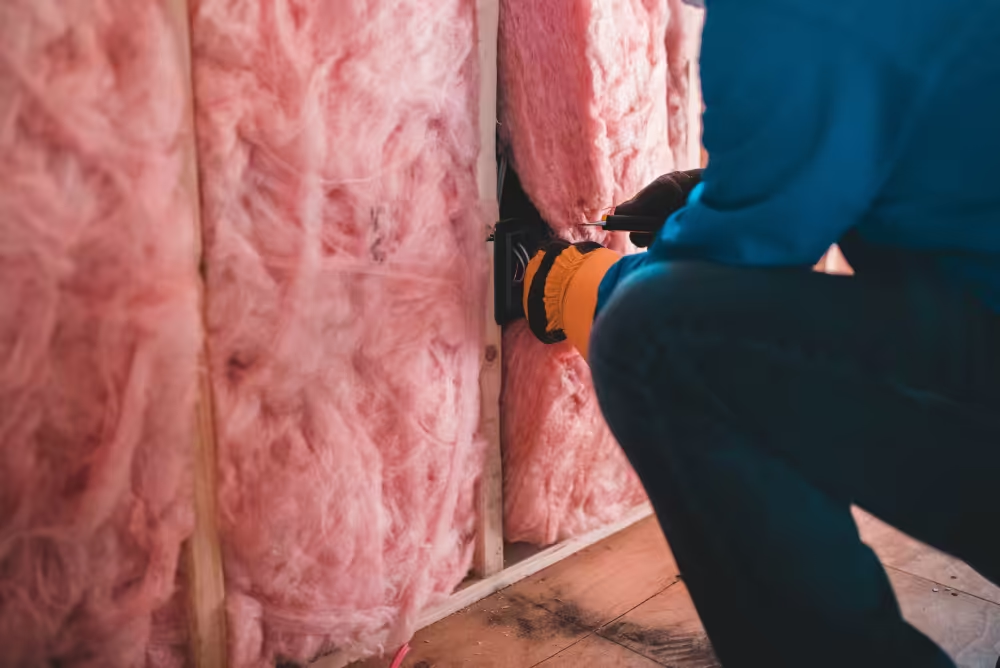
Spray polyurethane foam (SPF) insulation represents one of the most advanced and versatile insulation technologies available to the construction industry. Unlike traditional insulation materials that rely on mechanical retention or friction fit within cavities, spray foam is applied as a liquid that expands to fill and seal building cavities, creating a monolithic insulation and air barrier system. This comprehensive technical guide examines everything construction professionals need to know about spray foam insulation, including the chemistry, application methods, performance characteristics, safety requirements, and design considerations for both open-cell and closed-cell foam systems.
For a deeper understanding of building science principles, explore our detailed guide on Door Locks which provides additional technical context for insulation and energy efficiency in construction.
The Chemistry and Physics of Spray Foam Insulation
Understanding Mortar Properties is essential knowledge for construction professionals working on building envelope performance and thermal protection systems.
Spray polyurethane foam is created through a chemical reaction between two liquid components, isocyanate (commonly referred to as side A) and polyol resin (side B), which are combined at the spray gun tip in a precise ratio, typically 1:1 by volume. Upon mixing, the components undergo an exothermic reaction that produces polyurethane polymer while a blowing agent generates gas bubbles that expand the foam to 30-60 times its liquid volume. The reaction is essentially instantaneous, with the foam expanding and curing within seconds of application. The chemical formulation determines the foam density, cell structure (open or closed), R-value, and physical properties.
The expansion and curing of spray foam are controlled by the chemistry of the blowing agent and the catalyst system. In closed-cell foam, the blowing agent is typically a hydrofluoroolefin (HFO) or hydrofluorocarbon (HFC) with low thermal conductivity, creating small, sealed cells filled with the blowing agent gas. These sealed cells contribute to the high R-value of closed-cell foam (R-6.0 to R-7.0 per inch) because the blowing agent gas has lower thermal conductivity than air. In open-cell foam, water reacts with isocyanate to produce carbon dioxide as the primary blowing agent, creating larger, interconnected cells that allow air to fill the foam structure. The open-cell structure has a lower R-value (R-3.5 to R-4.0 per inch) but provides superior sound absorption and lower material cost.
| Property | Closed-Cell SPF | Open-Cell SPF |
|---|---|---|
| Density | 1.7-2.0 lb/ft³ | 0.4-0.7 lb/ft³ |
| R-Value per inch | R-6.0 to R-7.0 | R-3.5 to R-4.0 |
| Water absorption | < 0.5% by volume | Up to 15% by volume |
| Vapor permeance (at 2″) | < 1.0 perm | 5-10 perms |
| Air barrier | Yes (when > 1.5″) | Yes (when correctly installed) |
| Structural reinforcement | Significant (200-300% racking strength increase) | Minimal |
| Sound attenuation (STC) | STC 35-40 | STC 40-50 |
| Typical cost per board foot | $1.00-2.00 | $0.50-0.90 |
Application Methods and Equipment Requirements
For professionals seeking comprehensive guidance on related topics, the article on High Performance Buildings offers valuable insights into best practices and technical specifications for building systems.
Spray foam insulation requires specialized equipment and trained applicators to achieve consistent quality and performance. The basic equipment setup includes proportioning pumps that precisely meter and pressurize the two chemical components, heated hoses that maintain the chemicals at the correct temperature (typically 120-140°F depending on the formulation), and a spray gun that atomizes and mixes the components at the point of application. The equipment must be calibrated and maintained to deliver the correct ratio, temperature, and pressure for the specific foam formulation being used. Variations in any of these parameters can result in off-ratio foam that fails to cure properly, has reduced R-value, or exhibits poor adhesion and physical properties.
Surface preparation is critical for successful spray foam application. The substrate must be clean, dry, and free of oil, dust, frost, rust, and loose materials that could interfere with foam adhesion. For wood substrates, the moisture content must be below 18% to prevent adverse reactions between the foam chemicals and excess water. For concrete and masonry substrates, the surface should be clean and free of form release agents, curing compounds, and efflorescence. The substrate temperature must be within the manufacturer’s specified range, typically 60-90°F for most spray foam formulations. Application temperatures below the minimum range result in poor adhesion, reduced foam rise, and lower R-value, while excessive temperatures can cause the foam to expand too rapidly, creating voids and non-uniform density.
Environmental conditions during application must be carefully controlled. The ambient temperature should be between 40-90°F, humidity should be below 80%, and the substrate should be protected from precipitation during and immediately after application. Wind can disrupt the foam spray pattern and cause overspray drift, so wind screens or indoor application are recommended when wind speeds exceed 10-15 mph. The work area must be well-ventilated to remove airborne isocyanates and other volatile compounds generated during the spraying process. When applying foam in confined spaces such as attics and crawlspaces, forced-air ventilation with local exhaust at the application point is required to maintain airborne chemical concentrations below permissible exposure limits.
Design Considerations for Spray Foam Assemblies
Additional reference material on Detailed Analysis Of Construction Measures Materia can help construction teams implement proper insulation and moisture control strategies more effectively on their projects.
Unvented roof assemblies using spray foam insulation require careful design to manage moisture and ensure long-term durability. The International Residential Code (IRC) allows the use of unvented attic assemblies when air-impermeable insulation (such as closed-cell spray foam) is applied directly to the underside of the roof deck. The minimum R-value of the air-impermeable insulation is determined by the climate zone, with the requirement increasing in colder climates to prevent condensation on the underside of the roof sheathing. For climate zones 5-8, the IRC requires R-20 in combination with air-permeable insulation or R-30 of air-impermeable insulation alone. When open-cell spray foam is used, a vapor retarder is typically required on the interior side of the foam in cold climates to limit vapor diffusion into the foam layer.
Spray foam adhesion to the substrate determines the structural performance of the insulated assembly. Closed-cell spray foam at 2.0 lb/ft³ density has a tensile adhesion strength of 15-30 psi to clean wood, concrete, and metal substrates. This adhesion provides significant structural reinforcement to wall and roof assemblies, increasing the racking strength of wood-frame walls by 200-400% and providing resistance to wind uplift in roof assemblies. However, the adhesion must be verified by field testing in critical applications, and the foam must be applied to properly prepared substrates to achieve the specified bond strength. Adhesion failure can occur if the foam is applied to contaminated, wet, or excessively cold surfaces, or if the foam is over-applied in thicknesses that generate excessive exothermic heat and cause delamination within the foam itself.
The interaction between spray foam and other building systems requires careful coordination. Electrical codes require that wiring in contact with spray foam be rated for the maximum operating temperature of the foam system (typically 200-250°F during the exothermic reaction). Non-metallic sheathed cable (Romex) can be in contact with spray foam, but the cable must not be buried within the foam in a manner that prevents heat dissipation—the National Electrical Code requires that cables maintain their ampacity when installed in insulation. Plumbing pipes should not be embedded in closed-cell spray foam because the foam will prevent heat loss from hot water pipes and can trap moisture against cold water pipes, potentially causing corrosion or freezing in exterior walls.
Safety Requirements and Regulatory Compliance
Spray foam insulation installation involves significant health and safety hazards that require comprehensive protection measures. The isocyanate component is a respiratory sensitizer that can cause asthma and allergic reactions after repeated exposure. OSHA’s permissible exposure limit (PEL) for isocyanates is 0.02 ppm as an 8-hour time-weighted average ceiling. All personnel in the spray area must wear supplied-air respirators with full-face protection, chemical-resistant coveralls, and gloves. The spray area must be isolated from occupied spaces, and a decontamination area must be established for personnel exiting the spray zone.
Fire safety requirements for spray foam are established by the IRC and IBC, which require that foam plastic insulation be separated from the building interior by an approved thermal barrier of 1/2-inch gypsum board or equivalent. In attics and crawlspaces where the thermal barrier requirement may not be practical, the code allows an ignition barrier (such as 1.5-inch mineral wool, 6-mil polyethylene, or intumescent coating) in lieu of the full thermal barrier, provided the space is not intended for storage or occupancy. Spray foam formulations must meet flame spread and smoke development requirements of ASTM E84, with a flame spread index of 75 or less and smoke development index of 450 or less for most applications.
Spray foam insulation offers unparalleled performance in terms of air sealing, thermal resistance, and moisture control when properly designed and installed. The combination of high R-value per inch, seamless air barrier creation, structural reinforcement, and moisture management capability makes spray foam the insulation of choice for high-performance building envelopes. However, the specialized equipment requirements, safety considerations, and material costs demand that spray foam be specified and applied by qualified professionals who understand both the capabilities and the limitations of this sophisticated building material.